Ministry
Ministry of Home Affairs
The Ministry of Home Affairs is the Government of India's department for internal security and domestic order. It oversees the central armed police forces, border management, centre–state relations, disaster management and internal-security policy. It is the institution most responsible for security inside India's borders, as distinct from external defence.
Updated
- Headquarters
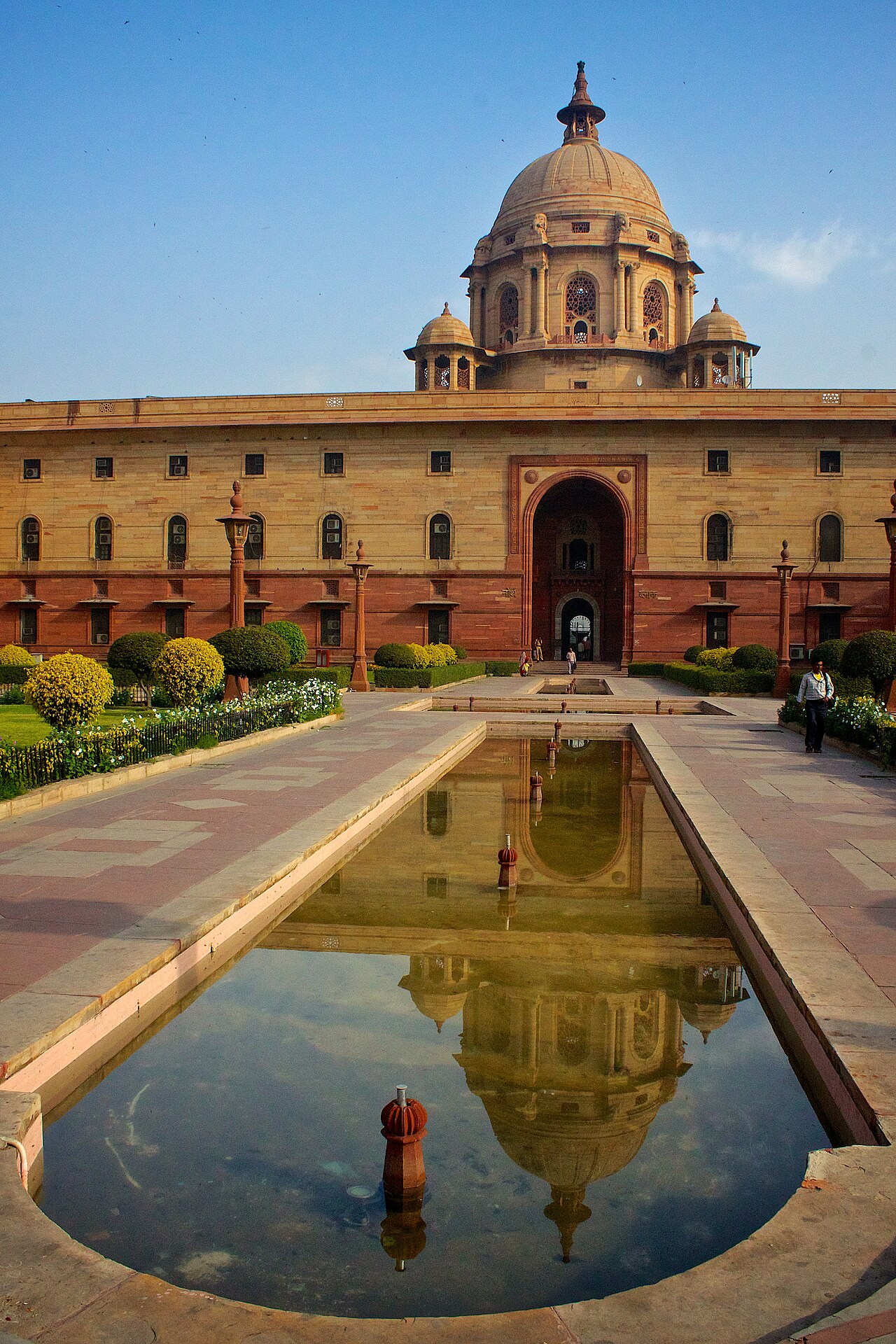
- North Block, New Delhi
- Forces overseen
- Central Armed Police Forces (CAPFs)
- Budget (2026-27)
- ₹2.55 lakh crore
- Naxal-affected districts
- 38 (2024), from 126 (2018)
Role
The Home Ministry runs India’s internal-security architecture. It controls the Central Armed Police Forces — the BSF, CRPF, CISF, ITBP and SSB — manages the country’s land borders, and coordinates centre–state security and disaster response. Its remit is domestic order and internal threats, complementing the external mandate of the Indian Army and the defence establishment.
Desk maintained by IndiaStand editorial cycles. Officeholders are transient; this dossier tracks the institution.
Timeline since 1947
- reference
Ministry of Home Affairs constituted
Inherited responsibility for internal order and the integration of princely states.
- reference
Reorganisation of Jammu & Kashmir
Article 370 changes and the reorganisation of the state into two union territories were administered through the ministry.
- official
National Cyber Crime Reporting Portal launched as a citizen filing channel
The ministry launched cybercrime.gov.in so that cybercrime complaints could be filed without visiting a police station, with complaints routed online to the law-enforcement agency of the relevant state or union territory.
- official
NIA (Amendment) Act 2019 extends the agency's jurisdiction beyond India
The amendment gave the National Investigation Agency extra-territorial jurisdiction over terrorism offences committed outside India where Indian citizens or property are victims, and added explosive substances, human trafficking, manufacture or sale of prohibited arms and cyber terrorism to its schedule.
- official
UAPA (Amendment) Act 2019 lets the Centre designate individuals as terrorists
The amendment empowered the central government to proscribe individuals, not only organisations, as terrorists — four were designated immediately after — and empowered the NIA to seize or forfeit property representing proceeds of terrorism in cases it investigates.
- official
Citizenship (Amendment) Act 2019 added to the ministry's statute book
The ministry piloted legislation granting Indian citizenship to Hindu, Sikh, Buddhist, Jain, Parsi and Christian persons from Pakistan, Afghanistan and Bangladesh on grounds of religious persecution; MHA records deliberations with North-Eastern stakeholders whose objections it says were addressed in the final Act.
- official
CAPF Institute of Medical Sciences established at ₹2,091 crore
CAPFIMS was set up at a cost of ₹2,091 crore as a dedicated medical institute for the central armed police forces, with a 970-bed referral and research hospital, a 500-bed general hospital, a 300-bed super-speciality hospital and 170 ICU beds.
- official
LWE deaths fall below 100 for the first time in four decades
MHA's review records 287 Naxalites neutralised and 992 arrested during 2024, 14 of them Politburo members, with the death toll in LWE-affected areas below 100 for the first time in forty years; security spending in LWE-affected states nearly tripled to ₹3,006 crore.
- official
Cabinet extends the Safety of Women umbrella scheme at ₹1,179.72 crore
The Union Cabinet approved MHA's proposal to continue the umbrella scheme on Safety of Women for 2021-22 to 2025-26 at ₹1,179.72 crore, of which ₹885.49 crore comes from the ministry's own budget and ₹294.23 crore from the Nirbhaya Fund.
- official
Left-Wing Extremism footprint at a multi-decade low
MHA figures put LWE-affected districts at 38, down from 126 in 2018, and the 'most affected' at 6; violence incidents fell from 1,936 (2010) to 374 (2024).
- official
Three new criminal codes replace the IPC, CrPC and Evidence Act
The Bharatiya Nyaya Sanhita, Bharatiya Nagarik Suraksha Sanhita and Bharatiya Sakshya Adhiniyam came into force on 1 July 2024, replacing the colonial-era Indian Penal Code, Code of Criminal Procedure and Indian Evidence Act that the ministry had administered since independence.
- official
MHA stands up a cyber-fraud enforcement layer under I4C
The ministry dedicated the Cyber Fraud Mitigation Centre — a joint law-enforcement and private-sector body — and launched the Samanvay data-sharing platform, a Suspect Registry built on National Cybercrime Reporting Portal identifiers with banks and financial intermediaries, and a programme to raise 5,000 Cyber Commandos across states and central police organisations.
- official
Vibrant Villages Programme-2 approved with a ₹6,839 crore outlay
The Union Cabinet approved a second phase of the border-village development programme with a total outlay of ₹6,839 crore, extending the ministry's border-management remit from policing into settlement and infrastructure.
- official
Most-affected LWE districts down to 3 as the March 2026 deadline nears
MHA's 2025 review puts the most-affected LWE districts at 3 and total affected districts at 11, down from 18, with 312 cadres neutralised during the year; 258 Naxalites surrendered in Chhattisgarh and Maharashtra in a single tranche.
- official
Immigration and Foreigners Bill 2025 passed by the Lok Sabha
The ministry piloted a consolidated immigration law through the Lok Sabha, framed around a complete and up-to-date record of every foreign national entering India — who enters, when, for how long and for what purpose.
- official
Caste enumeration to be included in the next Census
The Cabinet Committee on Political Affairs decided to include caste enumeration in the forthcoming census, reversing the practice of counting only Scheduled Castes and Scheduled Tribes; the Registrar General of India under MHA administers the count.
- reference
Operation Black Forest
The largest anti-Naxal offensive to date, in the Karregutta Hills on the Chhattisgarh–Telangana border; the CPI (Maoist) general secretary was among those killed weeks later.
- official
Census 2027 notified in two phases with a 1 March 2027 reference date
The ministry notified Population Census 2027 in two phases with a reference date of 00:00 hours on 1 March 2027; for Ladakh and the non-synchronous snow-bound areas of Jammu and Kashmir, Himachal Pradesh and Uttarakhand the reference date is 00:00 hours on 1 October 2026.
- official
'Naxal-Mukt Bharat' deadline
The Ministry set 31 March 2026 as its target to eliminate Left-Wing Extremism nationwide, the centrepiece of an internal-security consolidation drive.
- gdelt
Home Minister declares the three internal-security threats 'by and large' resolved
Speaking in Bastar, the Home Minister said India was 'by and large' free of Left-Wing Extremism, Jammu & Kashmir terrorism and Northeast insurgency; critics noted residual Maoist activity in a few districts.
Frequently asked
- What is Ministry of Home Affairs?
- The Ministry of Home Affairs is the Government of India's department for internal security and domestic order. It oversees the central armed police forces, border management, centre–state relations, disaster management and internal-security policy. It is the institution most responsible for security inside India's borders, as distinct from external defence.
- When was Ministry of Home Affairs established?
- Ministry of Home Affairs was established 1947.
- What does Ministry of Home Affairs do?
- Its remit covers Internal security and counter-insurgency policy, Central Armed Police Forces (BSF, CRPF, CISF, ITBP, SSB), Border management, Centre–state relations and union territories, Disaster management.
- What is the latest on Ministry of Home Affairs?
- As of 2026-07-05: Home Minister declares the three internal-security threats 'by and large' resolved. Speaking in Bastar, the Home Minister said India was 'by and large' free of Left-Wing Extremism, Jammu & Kashmir terrorism and Northeast insurgency; critics noted residual Maoist activity in a few districts.
Official sources
The government's own pages for this institution — go straight to the primary.
- Official website
www.mha.gov.in/
-
Canonical MHA home page; hub for divisions, acts and notifications.
www.mha.gov.in/en
- MHA Annual Reports reports
Archive of MHA annual reports covering internal security, border management, crime and disaster management.
www.mha.gov.in/en/documents/annual-reports
-
MHA's statistics body; publishes Crime in India, ADSI and prison statistics, runs CCTNS.
www.ncrb.gov.in/
- National Disaster Management Authority department
Apex disaster-management body chaired by the Prime Minister, under MHA's Disaster Management Division.
ndma.gov.in/
- Bharatiya Nyaya Sanhita, 2023 (India Code) legislation
Bare text of the criminal code administered by MHA, which replaced the IPC.
www.indiacode.nic.in/handle/123456789/20062
- MHA Press Releases press
Ministry's own press-release archive, indexed by year (page is a thin index that links year-wise listings).
www.mha.gov.in/en/commoncontent/mha-press-releases
Related briefs
- Andaman and Nicobar Islands: the political economy of a strategic frontier without a legislature 2026-07-28
- Arunachal Pradesh: the political economy of a frontier state the Union underwrites 2026-07-28
- Assam: the political economy of a border, tea and hydrocarbon state 2026-07-28
- Bihar: the political economy of demographic weight without an industrial base 2026-07-28
- Chandigarh: the political economy of a shared capital under direct Union rule 2026-07-28
- Chhattisgarh: the political economy of a mineral-and-forest state, and its seams with the Union 2026-07-28
- Dadra and Nagar Haveli and Daman and Diu: the political economy of a Union Territory that is a fiscal instrument 2026-07-28
- Delhi (NCT): the political economy of the capital that is governed twice 2026-07-28
- Gujarat: the political economy of an industrial, maritime and border state 2026-07-28
- Caste and reservation: India's quota architecture, its 50% ceiling and the count that reopens it 2026-07-28
- India's demographics: the world's largest population, a below-replacement birth rate, and a census overdue 2026-07-28
- India's urban transition and migration: the gap between city growth and municipal capacity 2026-07-28
- Jammu and Kashmir: the political economy of a demoted, transfer-fed Union Territory 2026-07-28
- Jharkhand: the political economy of a resource state that is not a rich state 2026-07-28
- Ladakh: the political economy of a border territory governed without a legislature 2026-07-28
- Lakshadweep: the political economy of the Union's smallest, un-legislatured territory 2026-07-28
- Manipur: the political economy of a transfer-funded border state 2026-07-28
- Meghalaya: the political economy of a Sixth Schedule border state 2026-07-28
- Mizoram: the political economy of a border state bound to the Union by a peace settlement 2026-07-28
- Nagaland: the political economy of a constitutional-exception border state the Union underwrites 2026-07-28
- Puducherry: the political economy of a union territory that governs like a state 2026-07-28
- Odisha: the political economy of a mineral state on a cyclone coast, and its seams with the Union 2026-07-28
- Punjab: the political economy of a grain-surplus border state that shares its own capital 2026-07-28
- Rajasthan: the political economy of a border-and-desert state 2026-07-28
- Sikkim: the political economy of the Union's smallest, richest, most transfer-dependent state 2026-07-28
- Telangana: the political economy of a services-and-pharma successor state 2026-07-28
- Uttar Pradesh: the political economy of the Republic's largest electorate 2026-07-28
- Tripura: the political economy of a Sixth Schedule border state 2026-07-28
- Uttarakhand: the political economy of a Himalayan border state with a plains engine 2026-07-28
- West Bengal after the 2026 verdict: the revised rolls and the Centre–state seam 2026-07-17
- India's permanent civil service: the IAS/IPS, lateral entry, and administrative reform 2026-07-06
- The Indian Coast Guard: coastal security, maritime enforcement, and fleet expansion 2026-07-06
- Reservation and the caste census: India's affirmative-action ledger reopens 2026-07-06
- India's internal-security consolidation: the 'Naxal-Mukt Bharat' deadline and the three-theatres doctrine 2026-07-05