Ministry
Ministry of Information and Broadcasting
The Ministry of Information and Broadcasting is the Government of India's apex department for the press, radio and television broadcasting, film certification and government communication. It runs the public broadcaster Prasar Bharati (Doordarshan and Akashvani), certifies films through the Central Board of Film Certification, and — under Part III of the IT Rules 2021 — oversees online news publishers and curated (OTT) content. It is the institution that sets the terms on which broadcast and, increasingly, digital audio-visual content reaches Indian audiences.
Updated
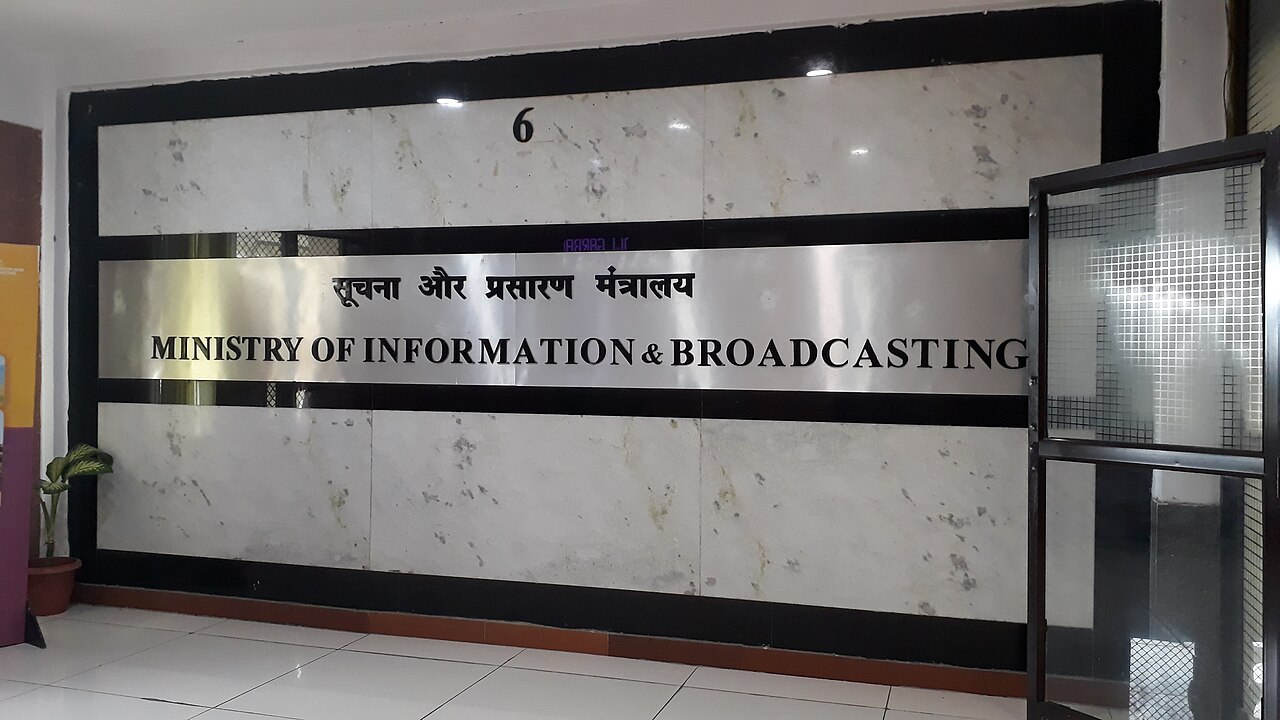
- Headquarters
- Shastri Bhawan, New Delhi
- Formed
- 1947 (at independence)
- Budget 2026-27 (BE)
- Rs 4,551.94 crore, of which about Rs 2,291.88 crore is allocated to Prasar Bharati
- Public broadcaster
- Prasar Bharati (Doordarshan television and Akashvani / All India Radio)
- Key statutes
- Cinematograph Act 1952; Cable Television Networks (Regulation) Act 1995; Prasar Bharati Act 1990; Press and Registration of Periodicals Act 2023; Part III of the IT Rules 2021
Role
The Ministry of Information and Broadcasting is the Union government’s department for the media India consumes: the press, radio and television broadcasting, film certification and the government’s own communication apparatus. It runs the public-service broadcaster Prasar Bharati — Doordarshan and Akashvani (All India Radio) — and administers the statutory bodies that gate content and inform the public: the Central Board of Film Certification, the Press Council of India, the Press Information Bureau, the Central Bureau of Communication and the Indian Institute of Mass Communication. Through the Cinematograph Act, the Cable Television Networks (Regulation) Act and the Press and Registration of Periodicals Act it sets who may broadcast, publish and screen, and on what terms.
Its second, newer face reaches the internet. Under Part III of the IT Rules 2021 the ministry oversees publishers of online news and current affairs and providers of curated audio-visual (OTT) content through a three-tier self-regulation mechanism topped by a government oversight layer — a mandate that runs alongside, and interlocks with, the intermediary rules administered by the Ministry of Electronics and Information Technology, and, since 2026, the broadcasting-authorisation regime being moved under the Telecommunications Act, 2023 overseen with the Ministry of Communications. This seam between broadcast regulation and digital-content rules is the ministry’s most contested territory.
Desk maintained by IndiaStand editorial cycles. Officeholders are transient; this dossier tracks the institution.
Timeline since 1947
- reference
Ministry constituted at independence
The department for information, broadcasting, the press and cinema was formed as one of the earliest ministries of independent India, inheriting All India Radio and the government's information services.
- reference
Prasar Bharati Act enacted
Parliament passed the Prasar Bharati (Broadcasting Corporation of India) Act, 1990 to convert Doordarshan and All India Radio into an autonomous public-service broadcaster; it was brought into force in 1997.
- reference
Cable Television Networks (Regulation) Act
The Act placed cable television under a registration-and-Programme-Code regime administered by the ministry, the statutory spine of Indian broadcast-content regulation for the next three decades.
- reference
Sports Broadcasting Signals (Mandatory Sharing with Prasar Bharati) Act enacted
Parliament passed the Bill in Lok Sabha on 8 March 2007 and Rajya Sabha on 9 March 2007, requiring content rights owners of sporting events of national importance to share the live broadcasting signal with the public broadcaster. The ministry still administers it: it notified a fresh list of sporting events of national importance on 12 June 2026, with a corrigendum on 24 June 2026.
- official
Policy guidelines for IPTV service issued
The ministry issued policy guidelines for Internet Protocol Television, its first framework for television delivered over telecom networks rather than cable or satellite, and the earliest seam between its broadcast mandate and the Department of Telecommunications licensing regime.
- official
Headend-in-the-Sky (HITS) broadcasting guidelines issued
The ministry issued guidelines for HITS operators, a satellite-fed distribution model created to let small cable operators carry digital signals without building their own headends; the guidelines were later amended on 6 November 2020.
- official
FM Radio Phase III policy notified
The ministry notified the FM Radio Phase III policy, the framework under which private FM frequencies were auctioned beyond the metros and into smaller towns, and the basis of the private radio industry's expansion for the following decade.
- reference
Cable TV Amendment Act mandates digital addressable systems
Passed by Lok Sabha on 13 December 2011 and Rajya Sabha on 19 December 2011, the amendment empowered the government to require encryption of all channels — including free-to-air — through digital addressable systems, gave cable operators a minimum of six months to install the equipment, and let TRAI fix the basic service tier and its rates. It converted analogue cable into an addressable, subscriber-metered industry.
- official
Policy guidelines for television rating agencies issued
The ministry issued the first policy guidelines for TV rating agencies in India, bringing audience measurement — the currency of the television advertising market — under a registration regime rather than leaving it to industry arrangement.
- official
Cabinet approves revised DTH licensing guidelines
The Cabinet approved a revision of the guidelines for Direct-to-Home services, with the ministry issuing the amendment to the DTH licence guidelines on 30 December 2020 — the first substantive rewrite of satellite pay-TV licensing terms since the original DTH regime.
- reference
IT Rules 2021 notified; Part III brings online news and OTT under the ministry
The Information Technology (Intermediary Guidelines and Digital Media Ethics Code) Rules, 2021 split administration: MeitY runs Part II (intermediaries) while the Ministry of Information and Broadcasting administers Part III, the Digital Media Ethics Code for online news publishers and curated (OTT) content.
- official
Cable TV Amendment Rules 2021 create a statutory three-tier grievance mechanism
The ministry notified the Cable Television Networks (Amendment) Rules, 2021, putting broadcast-content complaints on a statutory footing through self-regulation by broadcasters, self-regulating bodies and an inter-departmental oversight layer; it published an information booklet on 28 June 2021 and registered Level-II self-regulating bodies on 25 August 2021. This mirrored on television the three-tier structure Part III of the IT Rules 2021 had created for digital content four months earlier.
- official
Uplinking and Downlinking Guidelines 2022 replace the 2011 regime
The ministry notified new Uplinking and Downlinking Guidelines for satellite television channels, superseding the guidelines of 5 December 2011 that had governed channel permissions for a decade. Related registration guidelines for platform services offered by multi-system operators followed on 30 November 2022.
- reference
Press and Registration of Periodicals Act replaces the 1867 law
Parliament passed the Press and Registration of Periodicals Act, 2023, replacing the colonial-era Press and Registration of Books Act, 1867 with online registration of periodicals under a Press Registrar General; the same year the Cinematograph (Amendment) Act, 2023 modernised film certification and anti-piracy law.
- official
Press and Registration of Periodicals Rules 2024 operationalise the 2023 Act
The ministry notified the Press and Registration of Periodicals Rules, 2024 and constituted the Inter-Departmental Committee on the same day, switching periodical registration under the Press Registrar General to the online regime that replaced the Press and Registration of Books Act, 1867.
- official
Cinematograph (Certification) Rules 2024 rebuild the film certification rulebook
The ministry notified the Cinematograph (Certification) Rules, 2024, the operating rules for the certification regime rewritten by the Cinematograph (Amendment) Act, 2023 — which split the UA category into UA 7+, UA 13+ and UA 16+, made certificates perpetually valid instead of lapsing after ten years, and added piracy penalties of three months to three years imprisonment and fines up to 5 percent of production cost. The Cinematograph (Adjudication of Penalty) Rules, 2024 followed on 7 June 2024.
- gdelt
Draft Broadcasting Services (Regulation) Bill withdrawn
After a November 2023 draft and a revised July 2024 draft that would have extended a Programme Code and registration to OTT services, digital news and online content creators, the ministry withdrew the draft amid stakeholder criticism and recalled physical copies.
- official
Cable TV Rules amended; registering authorities named for cable operators and MSOs
The ministry notified amendments to the Cable Television Networks Rules, 1994 vide S.O. 65(E) and designated registering authorities for local cable operators and multi-system operators vide S.O. 315(E), moving cable registration off the Post Office counter and onto designated authorities, with an advisory to local cable operators issued the same day.
- official
Accessibility guidelines issued for OTT platforms
After consultations in October 2025, the ministry issued guidelines for accessibility of content on platforms of publishers of online curated content for persons with hearing and visual impairment — extending to OTT the accessibility standards it had set for television programmes in 2019 and for cinema exhibition in March 2024.
- official
Television Ratings Policy 2026 replaces the 2014 rating guidelines
Following consultations opened on 2 July 2025 and revised on 6 November 2025, the ministry issued the Television Ratings Policy 2026 for the regulation of television ratings, superseding the policy guidelines for television rating agencies of 16 January 2014; an amendment to the new policy was issued on 8 May 2026.
- gdelt
Draft Telecommunications broadcasting rules issued
The ministry released draft Telecommunications (Television, Radio and Associated Services) Rules, 2026 for consultation, moving authorisation of TV channels, DTH, HITS, IPTV, teleports, FM and community radio into the Telecommunications Act, 2023 framework in place of the 1995 Cable TV Act licensing regime, while omitting the earlier bill's OTT and content-control provisions.
Frequently asked
- What is Ministry of Information and Broadcasting?
- The Ministry of Information and Broadcasting is the Government of India's apex department for the press, radio and television broadcasting, film certification and government communication. It runs the public broadcaster Prasar Bharati (Doordarshan and Akashvani), certifies films through the Central Board of Film Certification, and — under Part III of the IT Rules 2021 — oversees online news publishers and curated (OTT) content. It is the institution that sets the terms on which broadcast and, increasingly, digital audio-visual content reaches Indian audiences.
- When was Ministry of Information and Broadcasting established?
- Ministry of Information and Broadcasting was established 1947.
- What does Ministry of Information and Broadcasting do?
- Its remit covers Information, broadcasting, press and film policy, Public broadcasting through Prasar Bharati (Doordarshan and Akashvani / All India Radio), Film certification: the Central Board of Film Certification under the Cinematograph Act, Registration of periodicals and government communication (Press Information Bureau, Central Bureau of Communication, Press Registrar General), Digital content oversight: Part III of the IT Rules 2021 for online news and curated (OTT) content.
- What is the latest on Ministry of Information and Broadcasting?
- As of 2026-07-06: Draft Telecommunications broadcasting rules issued. The ministry released draft Telecommunications (Television, Radio and Associated Services) Rules, 2026 for consultation, moving authorisation of TV channels, DTH, HITS, IPTV, teleports, FM and community radio into the Telecommunications Act, 2023 framework in place of the 1995 Cable TV Act licensing regime, while omitting the earlier bill's OTT and content-control provisions.
Official sources
The government's own pages for this institution — go straight to the primary.
- Official website
mib.gov.in/
-
Canonical ministry home; wings, organizations, directory, documents.
mib.gov.in/en
- Acts, Policies & Guidelines legislation
Ministry's own index of the Acts, policies, advisories and guidelines it administers.
mib.gov.in/en/documents/notification/acts-policy-guidelines
-
Bare Act with linked rules, notifications and orders; the core cable/TV distribution statute.
www.indiacode.nic.in/handle/123456789/1928?view_type=browse
- Reports & Publications reports
Annual reports, accounts-at-a-glance and other ministry report series.
mib.gov.in/en/documents/reports
- PIB — All Press Releases press
Press Information Bureau release archive (PIB is the ministry's own media wing); English pinned.
www.pib.gov.in/Allrel.aspx?reg=3&lang=1
- Central Board of Film Certification (CBFC) department
Statutory body under the ministry that certifies films for public exhibition.
www.cbfcindia.gov.in/cbfcAdmin/index.php
- Prasar Bharati department
Autonomous public service broadcaster (Doordarshan, Akashvani) under the ministry's aegis.
prasarbharati.gov.in/