Ministry
Ministry of Petroleum and Natural Gas
The Ministry of Petroleum and Natural Gas is the Government of India's apex department for oil and gas. It governs exploration, refining, pricing, distribution and — critically for an economy that imports the overwhelming share of its crude — the sourcing and security of oil supply. Through its planning arm and the state oil companies it oversees, it is the institution that administers where India buys its oil and on what terms. Its administration of the country's oil and gas traces to the dedicated petroleum bodies the Government of India stood up from the mid-1950s.
Updated
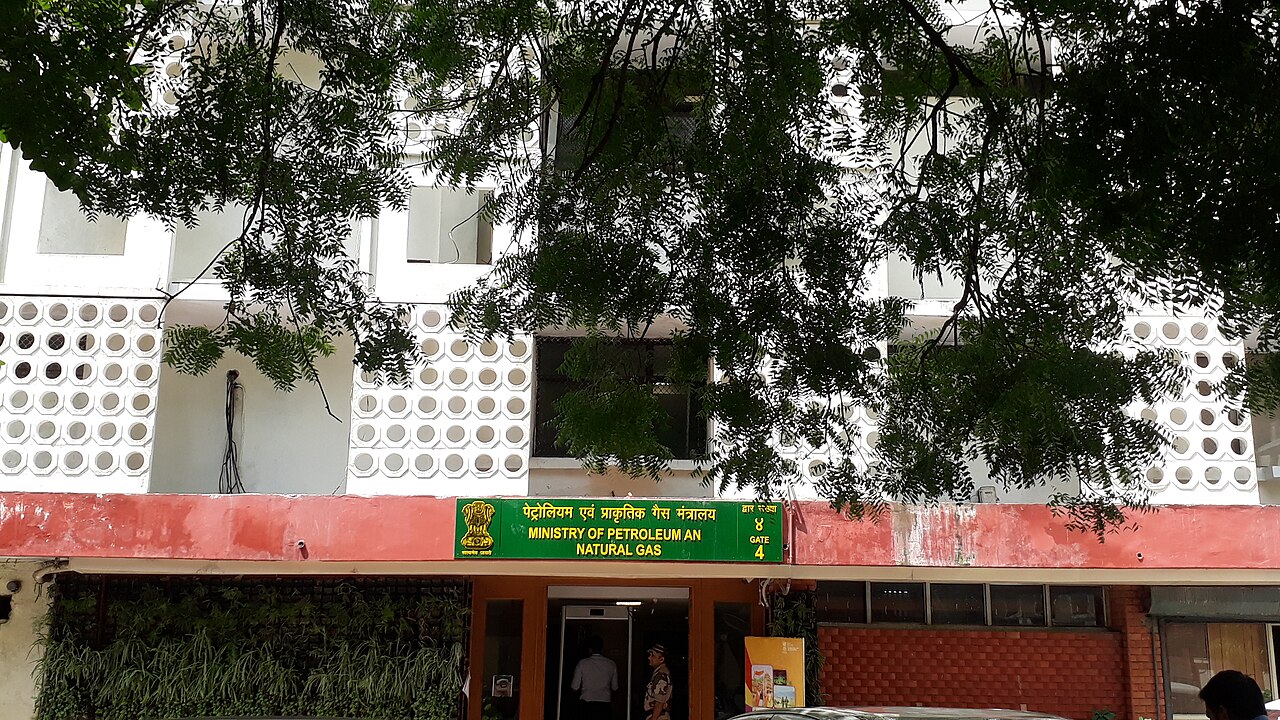
- Headquarters
- Shastri Bhawan, New Delhi
- Import dependence
- ~88% of crude oil imported (PPAC data, April 2024–February 2025)
- Strategic reserve
- 5.33 MMT at 3 sites (~9.5 days of crude cover, per PIB)
- Budget allocation
- ₹30,443 crore (2026-27, per PRS/Union Budget documents)
Role
The Ministry of Petroleum and Natural Gas administers the upstream-to-downstream chain of India’s oil and gas: exploration licensing (through the Directorate General of Hydrocarbons), demand and price analysis (through the Petroleum Planning and Analysis Cell), and the state companies — ONGC, Oil India, Indian Oil, Bharat Petroleum, Hindustan Petroleum and GAIL — that refine, market and distribute fuel across the country. Because India produces only a small fraction of the crude it burns, the ministry’s most consequential function is external: securing supply, diversifying sources and managing the price the economy pays for oil.
That external function makes the ministry a seat of power well beyond fuel retailing. Its choices on where India buys crude — Gulf, Russia, the United States, West Africa — sit at the intersection of energy policy, fiscal policy (fuel is a large share of the import bill and of consumer inflation) and foreign policy. It works alongside the Ministry of External Affairs on energy diplomacy and the Ministry of Finance on the subsidy and import-bill arithmetic, and its sourcing decisions are a core test of India’s strategic autonomy.
Desk maintained by IndiaStand editorial cycles. Officeholders are transient; this dossier tracks the institution.
Timeline since 1947
- reference
Dedicated petroleum administration set up
The Government of India established the Oil and Natural Gas Directorate as a subordinate office, the origin of the dedicated oil-and-gas administration the ministry descends from.
- reference
Oil and Natural Gas Commission raised
The directorate was raised to commission status, giving the state the commanding role in exploration and laying the public-sector foundation the ministry would administer.
- reference
Downstream oil brought into state hands
The nationalisation era placed refining and marketing under state companies that the ministry oversees.
- reference
Strategic petroleum reserve programme approved
Government approval led to Indian Strategic Petroleum Reserves Limited (ISPRL) and underground crude storage on both coasts.
- official
PNGRB Act enacted, creating a statutory downstream regulator
Act 19 of 2006 provided for a Petroleum and Natural Gas Regulatory Board to regulate refining, processing, storage, transportation, distribution, marketing and sale of petroleum, petroleum products and natural gas, expressly excluding production of crude oil and natural gas. It gave the ministry's downstream oversight a statutory arm outside the ministry itself.
- official
Petrol pricing deregulated on the Kirit Parikh expert group framework
The ministry announced that petrol and diesel pricing at both refinery gate and retail level would be market-determined, with an initial diesel increase of Rs.2 per litre at Delhi. Oil marketing companies' under-recoveries on the two fuels were put at roughly Rs.22,000 crore for the remainder of 2010-11.
- official
Diesel prices freed, ending the monthly-increment regime
The Cabinet Committee on Economic Affairs made diesel market-determined at both retail and refinery gate from midnight of 18-19 October 2014, replacing the January 2013 arrangement under which oil marketing companies raised diesel by 40-50 paise per litre per month.
- official
PAHAL direct benefit transfer of LPG subsidy goes nationwide
After a relaunch in 54 districts on 15 November 2014, the ministry extended PAHAL (DBTL) to the remaining 622 districts from 1 January 2015, covering 676 districts and over 15.3 crore LPG consumers, who buy cylinders at market price and receive subsidy in their bank accounts. A Rs.568 advance was paid on joining.
- official
Cabinet approves HELP, replacing profit sharing with revenue sharing
The Hydrocarbon Exploration and Licensing Policy introduced a uniform licence covering conventional and unconventional hydrocarbons, an open acreage policy, a revenue-sharing fiscal model in place of investment-multiple profit sharing, and marketing and pricing freedom. It removed the government's role in scrutinising contractors' costs, and graded royalty down from shallow to ultra-deep water.
- official
Pradhan Mantri Ujjwala Yojana launched for LPG connections to poor households
The scheme was launched at Ballia with a stated target of cooking gas connections for five crore below-poverty-line beneficiaries over three years, making the petroleum portfolio a mass welfare-delivery channel rather than only a fuel-supply administration.
- official
Daily revision of petrol and diesel retail prices rolled out nationwide
After a pilot from 1 May 2017 in Udaipur, Jamshedpur, Puducherry, Chandigarh and Vishakhapatnam, the public-sector oil marketing companies moved the entire country to daily revision of retail selling prices from 16 June 2017.
- official
Open Acreage Licensing Programme Bid Round I launched
The ministry offered 55 blocks covering 59,282 sq km, each carved out by prospective bidders themselves rather than designated by government — the first application of HELP's open acreage principle.
- official
Cabinet approves 6.5 MMT second phase of strategic petroleum reserves
Additional underground rock caverns were approved at Chandikhol, Odisha (4 MMT) and Padur, Karnataka (2.5 MMT), in principle on a public-private partnership model. Phase I's 5.33 MMT at Visakhapatnam, Mangalore and Padur was put at about 10 days of crude cover on FY2016-17 consumption, with Phase II adding about 12 days.
- official
Cabinet drops revenue share for blocks in unexplored basins
Under the approved exploration and licensing reforms, blocks in basins with no commercial production are bid out on exploration work programme alone, with no revenue or production share to government, though royalty and statutory levies remain payable. A ceiling on biddable revenue share was prescribed for producing basins.
- official
India releases 5 million barrels from strategic reserves in coordinated action
The ministry announced a release of 5 million barrels of crude from the strategic petroleum reserves, in parallel and in consultation with the United States, China, Japan and South Korea, citing supply held below demand by producing countries. It followed a 3 November 2021 central excise cut of Rs.5 on petrol and Rs.10 on diesel.
- gdelt
Russian crude enters India's import mix at scale
After the invasion of Ukraine and Western sanctions, discounted Russian barrels grew from almost nothing to about a third of India's crude imports.
- reference
Parliament passes the Oilfields (Regulation and Development) Amendment Bill
Passed by Rajya Sabha on 24 March 2025 after Lok Sabha on 12 March, the Bill amends the 1948 Act to widen mineral oils to cover coal bed methane and shale gas/oil, replace the mining lease with a petroleum lease, and decriminalise rule violations — substituting a Rs.25 lakh penalty for imprisonment of up to six months.
- official
OALP awards reach 172 blocks over 3.79 lakh sq km as Round X opens
The ministry reported 172 exploration blocks covering 3,78,652 sq km awarded across OALP Bid Rounds I to IX since HELP began in 2016, with Round X offering 25 blocks over 1,91,986 sq km launched on 15 April 2025. It also recorded 307 city gas distribution geographical areas authorised by PNGRB, covering almost all of the mainland.
- gdelt
US sanctions on Rosneft and Lukoil take effect
The 21 November 2025 wind-down deadline for the sanctions hit the two suppliers behind the bulk of India's Russian crude, pushing refiners toward non-sanctioned channels.
- gdelt
US-India trade framework drops the Russian-oil tariff
Washington removed the additional 25% tariff it had tied to India's Russian-oil purchases; the White House framed it as recognition of a commitment to stop buying Russian oil, which India did not publicly confirm.
- gdelt
Russian crude imports hit a record as the US waiver lapses
Ship-tracking data showed India's Russian crude at record volumes in June 2026, with a US sanctions waiver lapsing amid Strait-of-Hormuz supply disruption.
- official
Ministry records ethanol blending at 20% of petrol, five years ahead of schedule
A PIB backgrounder recorded blending rising from under 1.5% in 2013-14 to 20% in 2025-26, with ethanol procurement growing from about 38 crore litres in ESY 2013-14 to a projected 1,200-plus crore litres in 2025-26 and capacity from 421 crore litres in 2014 to about 2,000 crore litres in 2026. The same document put India's crude import dependence at close to 88.5%.
Frequently asked
- What is Ministry of Petroleum and Natural Gas?
- The Ministry of Petroleum and Natural Gas is the Government of India's apex department for oil and gas. It governs exploration, refining, pricing, distribution and — critically for an economy that imports the overwhelming share of its crude — the sourcing and security of oil supply. Through its planning arm and the state oil companies it oversees, it is the institution that administers where India buys its oil and on what terms. Its administration of the country's oil and gas traces to the dedicated petroleum bodies the Government of India stood up from the mid-1950s.
- When was Ministry of Petroleum and Natural Gas established?
- Ministry of Petroleum and Natural Gas was established 1955.
- What does Ministry of Petroleum and Natural Gas do?
- Its remit covers Exploration and production of oil and natural gas, Refining, distribution, marketing and pricing of petroleum products, Import, export and supply security of crude oil and LNG, Strategic petroleum reserves and demand planning, Oversight of the state oil and gas public-sector undertakings.
- What is the latest on Ministry of Petroleum and Natural Gas?
- As of 2026-07-06: Ministry records ethanol blending at 20% of petrol, five years ahead of schedule. A PIB backgrounder recorded blending rising from under 1.5% in 2013-14 to 20% in 2025-26, with ethanol procurement growing from about 38 crore litres in ESY 2013-14 to a projected 1,200-plus crore litres in 2025-26 and capacity from 421 crore litres in 2014 to about 2,000 crore litres in 2026. The same document put India's crude import dependence at close to 88.5%.
Official sources
The government's own pages for this institution — go straight to the primary.
-
Canonical ministry home: organisation structure, policies, statistics and notifications.
mopng.gov.in/en
- Annual Reports reports
Archive of the ministry's year-wise annual reports as PDFs.
mopng.gov.in/en/documents/annual-reports
-
Ministry's own rolling announcement and release archive.
mopng.gov.in/en/home/whatsnew
-
Attached office publishing oil and gas production, consumption, import and pricing statistics.
ppac.gov.in/
- Directorate General of Hydrocarbons (DGH) department
Upstream technical regulator: exploration blocks, OALP bid rounds, basin and reserves data.
www.dghindia.gov.in/
-
Statutory downstream regulator for refining, transport, distribution and city gas networks.
pngrb.gov.in/eng-web/
- Oilfields (Regulation and Development) Act, 1948 legislation
Principal Act on India Code governing mineral oil resources, with rules and notifications.
www.indiacode.nic.in/handle/123456789/1397?view_type=browse