Service of State
Indian Coast Guard
The Indian Coast Guard is an armed force of the Union under the Ministry of Defence, constituted under the Coast Guard Act, 1978 to protect India's maritime and national interests in its maritime zones. It is a seat of power because it is the country's principal maritime law-enforcement and search-and-rescue service and, since a 2009 Cabinet decision, the designated authority for coastal security in territorial waters — the standing armed presence that patrols India's exclusive economic zone day to day.
Updated
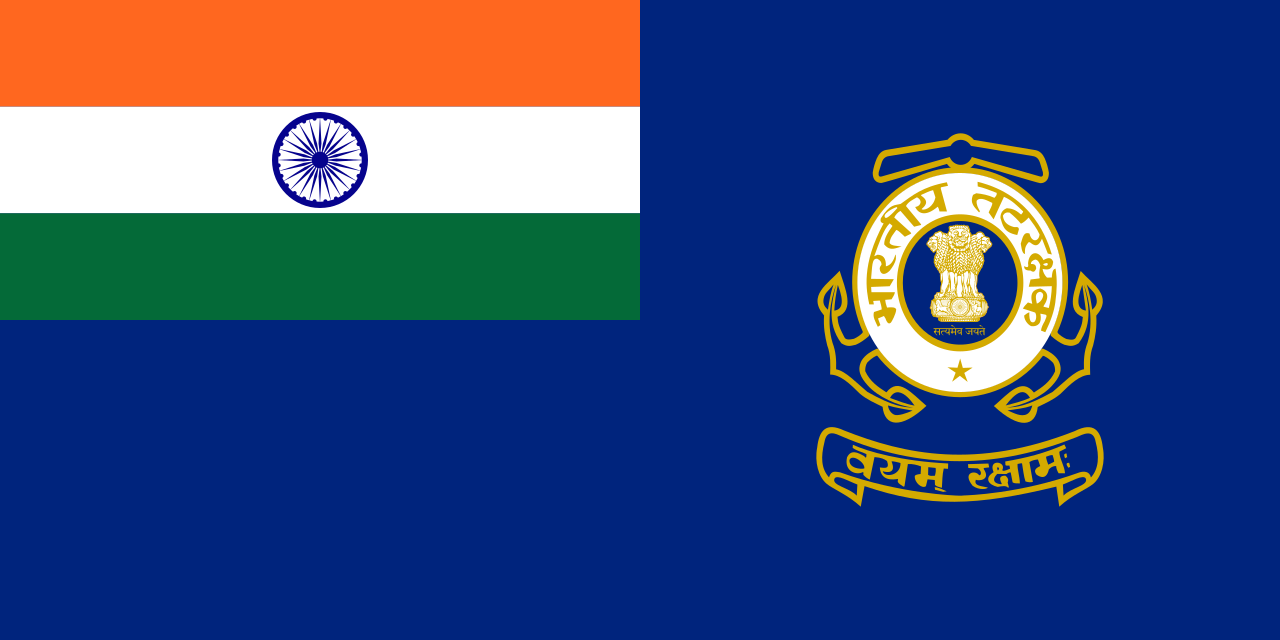
- Interim force raised
- February 1977
- Statutory basis
- Coast Guard Act, 1978
- Parent ministry
- Ministry of Defence
- Headquarters
- New Delhi
- Motto
- Vayam Rakshamah (We Protect)
- FY2025-26 allocation
- Rs 9,676.7 crore (Capital + Revenue)
- Stated force target
- 200 surface platforms and 100 aircraft by 2030
Role
The Indian Coast Guard is an armed force of the Union raised as an interim force in February 1977 and placed on a statutory footing by the Coast Guard Act, 1978. It sits under the Ministry of Defence and is commanded by the Director General of the Indian Coast Guard from headquarters in New Delhi. Section 14 of the Act charges it with protecting India’s maritime and national interests in the country’s maritime zones — a duty it discharges through law enforcement, search and rescue, protection of offshore installations, assistance to fishermen in distress, anti-smuggling work with Customs, marine environment protection and enforcement of maritime law. Operationally it is organised into Western and Eastern Seaboards and five Coast Guard Regions — North-West, West, East, North-East and Andaman & Nicobar, headquartered at Gandhinagar, Mumbai, Chennai, Kolkata and Port Blair — each under an Inspector General, with subordinate districts, coast guard stations and air stations.
Its standing as a seat of power rests on being the day-to-day armed presence in India’s exclusive economic zone and, since a February 2009 Cabinet Committee on Security decision taken after the 2008 Mumbai attacks, the designated authority for coastal security in territorial waters and for coordination between central and state agencies on coastal matters. That role is distinct from but complementary to the Indian Navy, which the same decision designated as responsible for overall maritime security, and from the coastal police forces of the states that report through the Ministry of Home Affairs. The service’s fleet expansion — indigenous fast patrol vessels, offshore patrol vessels, hovercraft and aircraft built largely in Indian yards — is the material expression of that enforcement mandate.
Desk maintained by IndiaStand editorial cycles. Officeholders are transient; this dossier tracks the institution.
Timeline since 1947
- reference
Interim Coast Guard raised
An interim Indian Coast Guard began operations with two corvettes and five patrol boats transferred from the Indian Navy; 1 February is observed as Raising Day.
- official
Coast Guard Act, 1978 enacted
Parliament passed the Coast Guard Act, 1978, constituting the service as an armed force of the Union under the Ministry of Defence and defining its duties under Section 14.
- reference
Designated lead for coastal security
After the 2008 Mumbai attacks, the Cabinet Committee on Security designated the Coast Guard as the authority responsible for coastal security in territorial waters, alongside the Coastal Surveillance Network of static sensors.
- reference
Largest Mumbai-coast oil spill tests the pollution-response mandate
The container ship MSC Chitra and the Khalijia III collided off Nhava Sheva, spilling fuel oil and roughly 200 containers into the Arabian Sea; the Coast Guard ran the surveillance and containment response until the leak was reported stopped on 9 August. Spill estimates in the record are contested, ranging from about 400 to about 800 tonnes.
- reference
Coast Guard interception of the Enrica Lexie opens a jurisdiction dispute
After two Indian fishermen were shot off Kerala, the Coast Guard intercepted the Italian-flagged tanker Enrica Lexie near the Lakshadweep archipelago and compelled it to Kochi port, triggering a decade-long contest over India's criminal jurisdiction in its contiguous zone.
- reference
Samarth-class OPV programme ordered — the post-2008 fleet expansion made material
A contract worth about Rs 1,800 crore was signed with Goa Shipyard Limited for six offshore patrol vessels, with a follow-on order for five more in August 2016 worth about Rs 2,000 crore; the first ship, ICGS Samarth, was commissioned on 10 November 2015.
- reference
NC3I network and IMAC commissioned, linking 51 Navy and Coast Guard centres
The Information Management and Analysis Centre at Gurugram was inaugurated as the nodal node of the National Command Control Communication and Intelligence Network, approved by the Defence Acquisition Council in 2012 at about Rs 450 crore, fusing coastal radar, AIS and shipping-database feeds across 51 Navy and Coast Guard operational centres.
- reference
Coastal Surveillance Network Phase-I completed with 46 radar stations
Phase-I of the static coastal radar chain, approved by the Cabinet Committee on Security on 28 February 2009 and run by the Coast Guard, was completed with 46 radar stations (36 mainland, 6 in Lakshadweep, 4 in the Andaman and Nicobar Islands) and 16 command centres, the last commissioned at Sagar Island in West Bengal, at a reported cost of over Rs 600 crore.
- reference
Coast Guard gets 16 of 32 ALH Mk-III helicopters in a joint contract
A contract of about Rs 8,000 crore was placed with Hindustan Aeronautics Limited for 32 Advanced Light Helicopter Mk-III airframes, split 16 to the Indian Navy and 16 to the Coast Guard — the service's largest single rotary-wing induction to that point.
- reference
Coastal Surveillance Network Phase-II approved — 38 more radar stations
Phase-II was approved at about Rs 800 crore for 38 additional static radar stations, 4 mobile surveillance stations and 5 further command centres, extending the Coast Guard-operated sensor chain that underpins its territorial-waters coastal-security mandate.
- reference
Arbitration award curtails Indian jurisdiction over the Enrica Lexie interception
The Permanent Court of Arbitration held that the Italian marines were entitled to immunity and that India had to cease exercising criminal jurisdiction, while ruling India entitled to compensation for loss of life and property; India's Supreme Court closed the criminal proceedings in June 2021.
- reference
Maritime Anti-Piracy Act gives Navy and Coast Guard high-seas custody powers
Parliament passed the Anti-Maritime Piracy Bill (introduced in Lok Sabha on 9 December 2019, passed by Lok Sabha on 19 December 2022 and Rajya Sabha on 21 December 2022), implementing UNCLOS to allow prosecution of piracy beyond territorial waters and applying to persons in the custody of the Indian Navy or Coast Guard regardless of nationality.
- reference
Supreme Court presses on women's permanent commission
The Supreme Court told the Union that arguments of 'functional difference' could not justify denying women officers permanent commission in the Coast Guard, saying it would order it if the government did not.
- reference
Follow-on ALH Mk-III order adds nine maritime-reconnaissance helicopters
An order of about Rs 8,073 crore for 34 ALH Mk-III airframes included 9 Mk-III (MR) maritime-reconnaissance machines for the Coast Guard, with a further 6 approved on 3 December 2024 at about Rs 2,901 crore; the first batch of four was delivered on 10 April 2026.
- gdelt
New Maritime Rescue Coordination Centre inaugurated at Chennai
The Ministry of Defence inaugurated a new Maritime Rescue Coordination Centre at Chennai, hardening the Coast Guard's coordination structure for the Indian Search and Rescue Region on the eastern seaboard.
- official
Foundation stone laid for Project Digital Coast Guard Tier-III data centre
The Coast Guard laid the foundation stone for the Tier-III Data Centre of Project Digital Coast Guard in New Delhi, the IT backbone intended to carry command, control and administration across the force's shore establishments and fleet.
- gdelt
FY2025-26 budget boost and 2030 target restated
On its Raising Day the Coast Guard reported a Capital budget rise of about 43% to Rs 5,000 crore and restated a stated target of 200 surface platforms and 100 aircraft by 2030.
- gdelt
ICGS Akshay commissioned
The Coast Guard commissioned ICGS Akshay, the fourth Adamya-class fast patrol vessel built by Goa Shipyard Limited with more than 65% indigenous content, under the Atmanirbhar Bharat programme.
Frequently asked
- What is Indian Coast Guard?
- The Indian Coast Guard is an armed force of the Union under the Ministry of Defence, constituted under the Coast Guard Act, 1978 to protect India's maritime and national interests in its maritime zones. It is a seat of power because it is the country's principal maritime law-enforcement and search-and-rescue service and, since a 2009 Cabinet decision, the designated authority for coastal security in territorial waters — the standing armed presence that patrols India's exclusive economic zone day to day.
- When was Indian Coast Guard established?
- Indian Coast Guard was established 1977.
- What does Indian Coast Guard do?
- Its remit covers Maritime law enforcement in India's maritime zones under the Coast Guard Act, 1978, Coastal security in territorial waters as the designated lead authority (since 2009), Search and rescue across the Indian Search and Rescue Region, Protection of offshore installations, artificial islands and other structures, Assistance to fishermen in distress and fisheries protection, Anti-smuggling and anti-narcotics operations in support of Customs and other agencies, Marine environment protection and pollution response.
- What is the latest on Indian Coast Guard?
- As of 2026-07-06: ICGS Akshay commissioned. The Coast Guard commissioned ICGS Akshay, the fourth Adamya-class fast patrol vessel built by Goa Shipyard Limited with more than 65% indigenous content, under the Atmanirbhar Bharat programme.
Official sources
The government's own pages for this institution — go straight to the primary.
-
Canonical CGHQ site under Ministry of Defence; org structure, Who's Who, news.
indiancoastguard.gov.in/
- ICG Press Releases press
The force's own dated press-release archive.
indiancoastguard.gov.in/press-release-
- Coast Guard Act, 1978 (India Code) legislation
Act No. 30 of 1978, the constituting statute; sections, rules, notifications.
www.indiacode.nic.in/handle/123456789/1734
-
MoD's page for the ICG as an armed force of the Union under the Department of Defence.
www.mod.gov.in/node/92128
- MoD Annual Reports reports
Ministry of Defence annual reports; ICG chapter covers fleet, ops and coastal security.
www.mod.gov.in/documents/annual-report
- Join Indian Coast Guard (recruitment portal) department
Official ICG recruitment portal (run for ICG by C-DAC); Navik/Yantrik/Assistant Commandant cycles.
joinindiancoastguard.cdac.in/
- ICG Search and Rescue other
National maritime SAR role, MRCC/MRSC coordination structure.
indiancoastguard.gov.in/search-and-rescue