State / UT
Nagaland
Nagaland is a state of the Indian Union formed on 1 December 1963 under the State of Nagaland Act, 1962, carved out of Assam's Naga Hills district and the Tuensang Frontier Division. It is one of the Republic's smallest units by weight — about 1.98 million people at the 2011 Census, a projected GSDP of roughly ₹45,020 crore in 2025-26, one Lok Sabha seat and one Rajya Sabha seat — governed by a unicameral 60-member Legislative Assembly at Kohima. Its defining structural feature is Article 371A, inserted by the Thirteenth Amendment alongside statehood, which bars Parliament from legislating for Nagaland on Naga customary law, religious and social practice, the administration of justice under customary law, and the ownership and transfer of land and its resources unless the Assembly resolves otherwise. That clause, a long-running Union-level negotiation over Naga political demands, and a statutory rather than panchayati local-government system make Nagaland a constitutional exception rather than a standard State List actor.
Updated
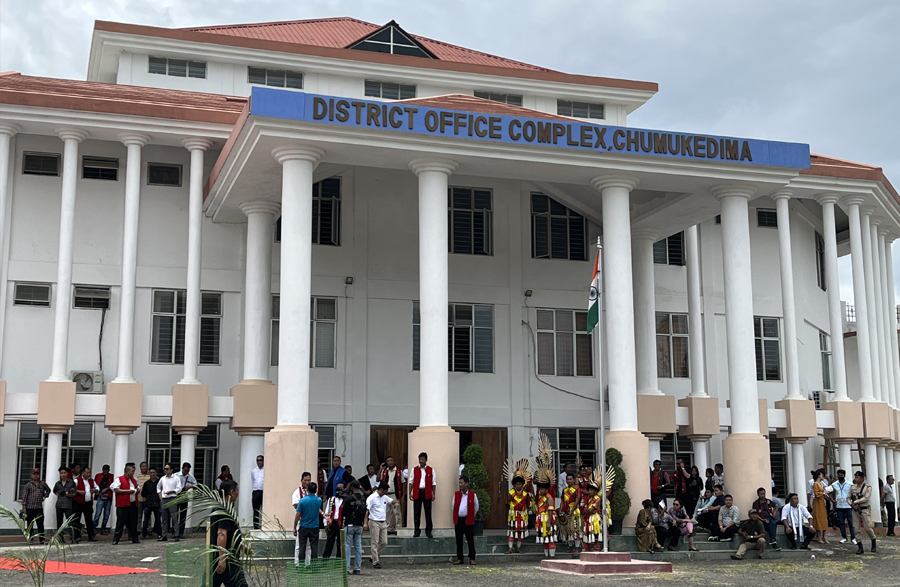
- Capital
- Kohima
- Formed
- 1 December 1963 (State of Nagaland Act, 1962); India's 16th state
- Legislature
- Unicameral — Nagaland Legislative Assembly, 60 seats
- Lok Sabha seats
- 1
- Rajya Sabha seats
- 1
- Population (2011 Census)
- 1,978,502
- Districts
- 17
- GSDP (2025-26 BE, current prices)
- ₹45,020 crore
- Constitutional provision
- Article 371A (Thirteenth Amendment, effective 1 December 1962)
Role
Nagaland is a constitutional exception that operates as an ordinary state most of the time. It runs the standard State List: police and law and order, land and land revenue, agriculture, health, education and local administration, through a government drawn from a unicameral 60-member Legislative Assembly seated at Kohima. Its weight in the Union is small — roughly 1.98 million people at the 2011 Census, a single Lok Sabha seat, a single Rajya Sabha seat, and a projected GSDP of about ₹45,020 crore for 2025-26 against total budgeted expenditure of roughly ₹20,096 crore, a ratio that indicates how much of the state’s activity rests on transfers from the Centre rather than on its own tax base. What makes it structurally distinct is Article 371A, inserted by the Thirteenth Amendment a year before statehood and the operative price of the 1960 sixteen-point settlement: Parliament cannot legislate for Nagaland on Naga religious or social practice, Naga customary law and procedure, justice administered under customary law, or the ownership and transfer of land and its resources, unless the Assembly resolves to accept it. Land and its subsoil are therefore not the state’s to dispose of in the way most states dispose of theirs, and the Governor carries an express constitutional special responsibility for law and order that has no counterpart in most of the Union.
Three live fault lines define its relationship with the Centre and its own periphery. The Naga political question has been in negotiation since the 1997 ceasefire and has produced a Framework Agreement in 2015 and an Agreed Position with other groups in 2017, neither converted into a published final settlement — so the Union’s principal counterparty on Naga political demands is not the state government. The Armed Forces (Special Powers) Act still applies to part of the state under ‘disturbed area’ notifications extended in short cycles, narrowed after the Oting killings of December 2021 but not lifted, which places a Union statute over the state’s own policing. And the six eastern districts, organised through the Eastern Nagaland People’s Organisation, press a Frontier Nagaland Territory demand directly on the Ministry of Home Affairs, boycotting the 2023 Assembly and 2024 general elections to the point of near-zero turnout — an internal federal claim routed past Kohima. Underneath all three sits a distinctive local-government architecture: Nagaland stands outside the panchayati raj system, governing through village councils and statutory urban bodies, and the Article 371A customary-law shield was itself the ground on which urban local body elections were contested and suspended for two decades until polls resumed in June 2024. As of 17 July 2026, the Fourteenth Assembly sits without a recognised opposition, every party in the House having joined the government.
Desk maintained by IndiaStand editorial cycles. Officeholders are transient; this dossier tracks the institution.
Timeline since 1947
- reference
Naga Hills-Tuensang Area created as a centrally administered unit
The Naga Hills district of Assam was merged with the Tuensang Frontier Division to form the Naga Hills-Tuensang Area, an autonomous unit administered from the Centre — the administrative precursor to the state.
- reference
Sixteen-Point Agreement between the Naga People's Convention and the Union
Talks between the Prime Minister and Naga People's Convention leaders produced a sixteen-point agreement conceding the formation of Nagaland as a full state within the Indian Union — the political basis for both the State of Nagaland Act and Article 371A.
- reference
Article 371A inserted by the Thirteenth Amendment
The Constitution (Thirteenth Amendment) Act took effect, inserting Article 371A. It provides that no Act of Parliament applies to Nagaland in respect of Naga religious or social practices, Naga customary law and procedure, administration of civil and criminal justice involving decisions according to Naga customary law, and ownership and transfer of land and its resources, unless the Legislative Assembly so resolves; it also vests the Governor with a special responsibility for law and order.
- reference
Nagaland becomes India's 16th state
The State of Nagaland Act, 1962 came into force with Kohima as capital. The first elected Legislative Assembly convened on 11 February 1964.
- reference
Shillong Accord; President's rule earlier that year
President's rule was imposed in March 1975; in November 1975 sections of the Naga underground agreed to give up arms under the Shillong Accord. Splinter groups rejected it, and the National Socialist Council of Nagaland was formed on 31 January 1980, splitting again on 30 April 1988 — the lineage of the armed groups the Union has negotiated with since.
- reference
Framework Agreement signed between the Union and NSCN-IM
The Government of India and the NSCN-IM signed a Framework Agreement; an 'Agreed Position' followed with the Naga National Political Groups in 2017. Both remain unconverted into a final settlement, and the substance of the Framework Agreement has not been published — the central unresolved item in Union–Nagaland relations.
- reference
Oting civilian killings reopen the AFSPA question
Fourteen civilians were killed during a security-forces operation in Mon district, prompting renewed demands from state bodies for repeal of the Armed Forces (Special Powers) Act. From April 2022 the Union Home Ministry narrowed the 'disturbed area' designation, which now covers a subset of districts rather than the whole state, extended by successive notifications.
- reference
District reorganisation: Chümoukedima, Niuland and Tseminyü created
Three new districts were notified on 18 December 2021, followed by Shamator on 19 January 2022 and Meluri in 2024, taking the state from 11 districts at statehood-era counts to 17.
- reference
Fourteenth Assembly elected; the House ends up without an opposition
Polling for the 60-member Assembly recorded 86.72% turnout. The NDPP-BJP alliance won 37 seats; the Naga People's Front fell from 26 to 2 after 21 of its MLAs had defected in April 2022. Every party in the House subsequently backed the government, leaving no recognised opposition. Two women were elected to the Assembly for the first time since 1963. Eastern Nagaland organisations pressed a boycott over their separate-territory demand.
- reference
Eastern districts shut down the Lok Sabha poll over the Frontier Nagaland demand
The Eastern Nagaland People's Organisation, which seeks a separate 'Frontier Nagaland Territory' covering the six eastern districts of Mon, Longleng, Tuensang, Noklak, Shamator and Kiphire on grounds of development neglect, enforced a boycott that produced near-zero turnout across those districts in the 2024 general election. The Union Home Ministry has floated a territory arrangement; it has not been implemented.
- reference
Urban local body elections held after a twenty-year gap
Nagaland held urban local body polls in June 2024, the first since 2004, reported at about 82% turnout. Elections had been blocked for years by objections that the 33% reservation for women — introduced by a 2006 amendment — conflicted with customary law protected by Article 371A; a Supreme Court direction to poll in 2017 triggered violent protests and the resignation of the then Chief Minister. The 2001 Municipal Act was repealed and replaced by the Nagaland Municipal Bill, 2023 before the polls proceeded.
Frequently asked
- What is Nagaland?
- Nagaland is a state of the Indian Union formed on 1 December 1963 under the State of Nagaland Act, 1962, carved out of Assam's Naga Hills district and the Tuensang Frontier Division. It is one of the Republic's smallest units by weight — about 1.98 million people at the 2011 Census, a projected GSDP of roughly ₹45,020 crore in 2025-26, one Lok Sabha seat and one Rajya Sabha seat — governed by a unicameral 60-member Legislative Assembly at Kohima. Its defining structural feature is Article 371A, inserted by the Thirteenth Amendment alongside statehood, which bars Parliament from legislating for Nagaland on Naga customary law, religious and social practice, the administration of justice under customary law, and the ownership and transfer of land and its resources unless the Assembly resolves otherwise. That clause, a long-running Union-level negotiation over Naga political demands, and a statutory rather than panchayati local-government system make Nagaland a constitutional exception rather than a standard State List actor.
- When was Nagaland established?
- Nagaland was established 1963-12-01.
- What does Nagaland do?
- Its remit covers State List subjects: law and order, police, land and land revenue, agriculture, health, education and local administration, Article 371A safeguards: Naga customary law, religious and social practices, customary-law justice, and ownership and transfer of land and its resources are insulated from Parliament absent an Assembly resolution, A Governor with a constitutional special responsibility for law and order in the state under Article 371A, Local government outside Part IX: village councils and statutory urban local bodies under state Acts, not a panchayati raj structure, Administration of 17 districts, including six eastern districts that are the subject of an autonomy demand before the Union Home Ministry.
- What is the latest on Nagaland?
- As of 2026-07-17: Urban local body elections held after a twenty-year gap. Nagaland held urban local body polls in June 2024, the first since 2004, reported at about 82% turnout. Elections had been blocked for years by objections that the 33% reservation for women — introduced by a 2006 amendment — conflicted with customary law protected by Article 371A; a Supreme Court direction to poll in 2017 triggered violent protests and the resignation of the then Chief Minister. The 2001 Municipal Act was repealed and replaced by the Nagaland Municipal Bill, 2023 before the polls proceeded.
Official sources
The government's own pages for this institution — go straight to the primary.
-
Government of Nagaland's official portal — departments, districts, notifications.
www.nagaland.gov.in/
- Nagaland Legislative Assembly (NeVA) legislation
Official National e-Vidhan portal for the 14th Assembly — members, business, questions, bills, debates.
nagaland.neva.gov.in/
-
Conducts and reports Nagaland's Assembly and Lok Sabha elections; statistical reports and rolls.
www.eci.gov.in/
-
Independent analysis of the state budget: GSDP, expenditure, receipts, fiscal deficit.
prsindia.org/budgets/states/nagaland-budget-analysis-2025-26
-
Comparable long-run state fiscal and economic series, including Nagaland.
www.rbi.org.in/Scripts/AnnualPublications.aspx?head=Handbook