Service of State
Judiciary of India
The Judiciary is the third branch of the Indian state and the guardian of its Constitution. An integrated single hierarchy runs from the Supreme Court of India at the apex, through the High Courts of the states, down to the district and subordinate courts. Through judicial review it can strike down laws and executive action, and through the "basic structure" doctrine it limits even Parliament's power to amend the Constitution. Uniquely among the world's major democracies, the higher judiciary also selects its own members — through the collegium — which is the institution's most contested feature.
Updated
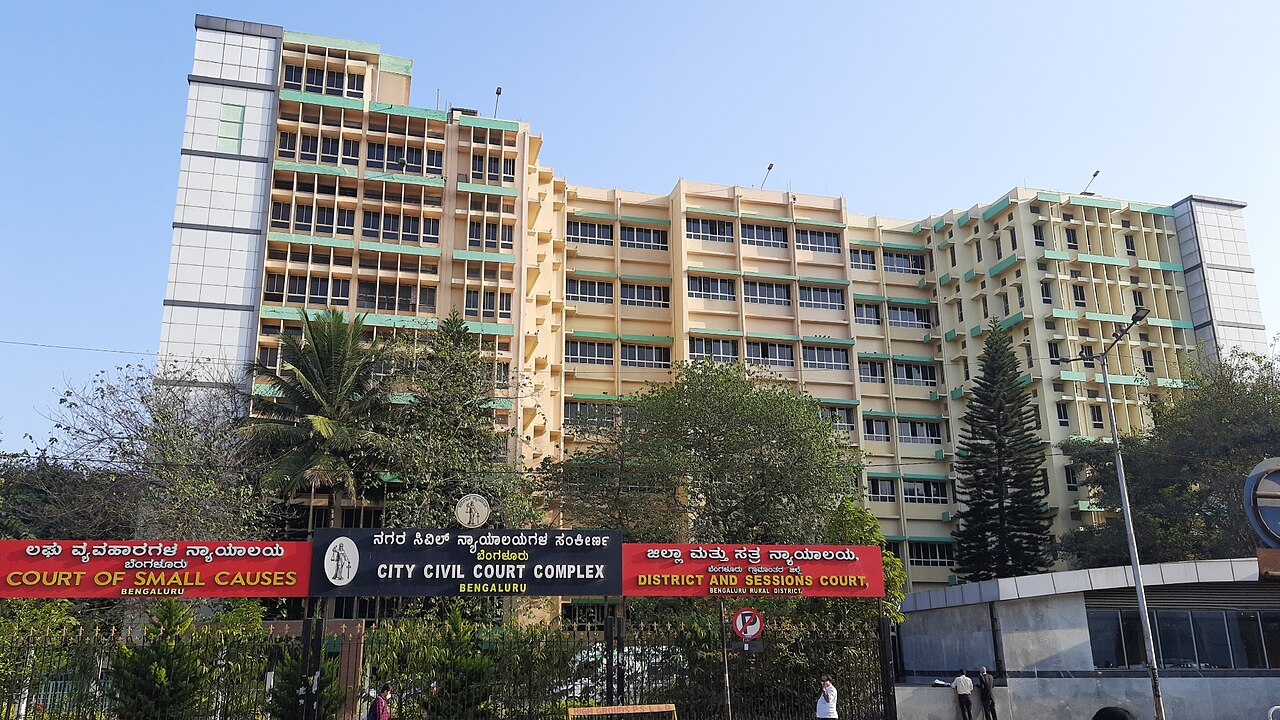
- Apex court established
- 28 January 1950
- Structure
- Supreme Court -> High Courts -> subordinate courts
- Sanctioned SC strength
- 38 judges (raised from 34 in 2026)
- Cases pending (all courts)
- ~5.4 crore (2025-26)
- Appointments
- Collegium system
Role
The Judiciary interprets and guards the Constitution. Its defining powers are judicial review — the authority to strike down legislation or executive action that violates the Constitution — and the basic structure doctrine, which places the Constitution’s foundational features beyond the reach of amendment. As an integrated system, a single hierarchy of courts — the Supreme Court, the High Courts of the states, and the district and subordinate courts — applies both central and state law nationwide, so that a right declared at the apex binds every court below it.
Why it is a service of state
Unlike the elected executive and legislature, the judiciary is a permanent, appointed arm of the state, insulated by design from the political cycle and outlasting any government. It is also, unusually, self-selecting: since the 1993 Second Judges Case the higher judiciary has chosen its own members through the collegium, and the 2015 defeat of the National Judicial Appointments Commission left that primacy intact. That places two live questions permanently at the centre of the institution — who appoints judges and whether the courts can clear their backlog — which IndiaStand tracks in a dedicated topic brief: India’s judiciary — appointments, pendency and reform.
Desk maintained by IndiaStand editorial cycles. Officeholders are transient; this dossier tracks the institution.
Timeline since 1947
- reference
Supreme Court of India established
Inaugurated on 28 January 1950, succeeding the Federal Court of India (1937) as the apex court under the new Constitution.
- reference
Kesavananda Bharati: the basic structure doctrine
A 13-judge bench held that Parliament cannot amend the Constitution's 'basic structure' — the foundational limit on the amending power, later used to strike down the NJAC.
- reference
Second Judges Case: the collegium is born
Reversing the executive-primacy reading of the First Judges Case (1981), the Court held that 'consultation' with the CJI means concurrence — giving the judiciary primacy over its own appointments through a collegium of senior judges.
- reference
Third Judges Case fixes the collegium's shape
A Presidential Reference settled that Supreme Court appointments are decided by the CJI and the four senior-most judges, and High Court appointments by the CJI and two senior-most judges.
- reference
Gram Nyayalayas Act brings village courts into force
The Gram Nyayalayas Act, 2008 (assented 7 January 2009) came into force on 2 October 2009 to take justice to citizens at their doorstep in rural areas. Uptake stayed far below design: as of 3 September 2019 only 208 Gram Nyayalayas were operational against a target of 5,000.
- official
e-Courts Phase I computerises 14,249 district and subordinate courts
Phase I of the e-Courts Mission Mode Project ran 2011-2015 on an outlay of Rs 935 crore, of which Rs 639.41 crore was spent; it computerised 14,249 district and subordinate courts, installed LAN at 13,683 courts and issued laptops to 14,309 judicial officers. Video conferencing was operationalised between 493 court complexes and 347 corresponding jails.
- official
e-Courts Phase II and the creation of the National Judicial Data Grid
Phase II (2015-2023) spent Rs 1,668.43 crore against an outlay of Rs 1,670 crore and extended digital infrastructure to 18,735 courts. It created the National Judicial Data Grid as the online repository of orders, judgments and case data for all computerised district and subordinate courts.
- reference
NJDG opens district-court pendency data to the public
The National Judicial Data Grid was launched for India's district courts on 19 September 2015, publishing institution, pendency and disposal statistics as a national repository rather than leaving them with individual courts.
- reference
NJAC struck down (Fourth Judges Case)
By 4:1, a Constitution Bench invalidated the 99th Amendment and the National Judicial Appointments Commission Act, 2014, holding that executive participation in appointments violated the basic structure — restoring the collegium.
- reference
Puttaswamy: right to privacy
A nine-judge bench held privacy to be a fundamental right intrinsic to life and liberty under the Constitution.
- reference
Supreme Court sanctioned strength raised to 34
The apex court's sanctioned judge strength was lifted to 31 in 2009 and to 34 in 2019, the last revision before the 2026 increase to 38.
- official
Courts shift to video-conferencing hearings
From 23 March 2020 the Supreme Court moved to hearing by video conferencing, holding 7,54,443 such hearings up to 4 June 2024. Across the system the district and subordinate courts heard 2,48,21,789 cases and the High Courts 90,21,629 by video conferencing to 31 October 2024, a total of 3.38 crore.
- reference
NJDG extended to the High Courts
The National Judicial Data Grid was extended to India's High Courts on 3 July 2020, putting the second tier of the judiciary's caseload on the same public dashboard as the district courts.
- official
Union Cabinet approves e-Courts Phase III at Rs 7,210 crore
The Union Cabinet approved e-Courts Phase III (2023-2027) as a Central Sector Scheme with an outlay of Rs 7,210 crore, over four times the funding for Phase II. It covers digital and paperless courts, digitisation of legacy court records, a cloud-based repository, saturation of court complexes with e-Sewa Kendras, and use of AI and OCR for pendency analysis.
- official
Supreme Court onboards NJDG, putting all three tiers on one portal
With the Supreme Court onboarding the National Judicial Data Grid on 14 September 2023, all three tiers of the judiciary came onto the portal. The NJDG-SCI instance, built by NIC with the Court's Computer Cell registry, publishes case-type and year-wise institution, pendency and disposal figures for the apex court.
- official
Mediation Act, 2023 enacted
Act 32 of 2023 was enacted on 14 September 2023 and enforced from 9 October 2023 under the Department of Legal Affairs. It promotes institutional mediation, makes mediated settlement agreements enforceable, provides a body for registration of mediators, and recognises community and online mediation.
- official
Virtual traffic courts handle 6 crore cases and Rs 649.81 crore in fines
Virtual Courts handling traffic challan cases were operational in 21 States and UTs, disposing of 6,00,29,546 cases; in 62,97,544 of them online fines totalling over Rs 649.81 crore were realised up to 31 October 2024.
- official
e-Sewa Kendras and NSTEP built out as the access layer
To bridge the digital divide, 1,394 e-Sewa Kendras were rolled out in district courts and 36 in High Courts, while the National Service and Tracking of Electronic Processes for serving summons reached 28 States and UTs. The NJDG by then carried more than 27.64 crore orders and judgments, with WAN connectivity at 99.5 per cent of court complexes.
- official
Live streaming of proceedings spreads to ten High Courts and the Supreme Court
Live streaming of court proceedings was under way in the High Courts of Gujarat, Gauhati, Orissa, Karnataka, Jharkhand, Patna, Madhya Pradesh, Uttarakhand and Calcutta, and in the Supreme Court, allowing media and other interested persons to follow hearings directly.
- reference
53rd Chief Justice of India takes oath
The office of the Chief Justice passed to its 53rd holder, with a tenure running to February 2027; the CJI heads the collegium and allocates the Court's work as 'master of the roster'.
- reference
Supreme Court strength raised 34 -> 38
The Union Cabinet cleared the Supreme Court (Number of Judges) Amendment Bill, 2026; an Ordinance lifting the sanctioned strength from 34 to 38 judges was notified in the Gazette on 16 May 2026 — the first revision since 2019, against record pendency.
Frequently asked
- How are Supreme Court judges appointed in India?
- By the President, on the recommendation of the Supreme Court collegium — and in practice the collegium's recommendation binds. Article 124 says the President appoints "after consultation with" the Chief Justice and such other judges as the President deems necessary, but the Second Judges Case (1993) held that "consultation" means concurrence, reversing the executive-primacy reading of the First Judges Case (1981). The Third Judges Case (1998), on a Presidential Reference, fixed the shape: Supreme Court appointments are decided by the Chief Justice and the four senior-most judges, High Court appointments by the Chief Justice and two senior-most judges. The government's one attempt to change this failed — on 16 October 2015 a Constitution Bench struck down the 99th Amendment and the National Judicial Appointments Commission Act, 2014 by 4:1, holding that executive participation in appointments violated the basic structure. Sanctioned strength was raised from 34 to 38 judges by ordinance notified on 16 May 2026, the first revision since 2019. reference · source 1 source 2
- What is the collegium system in India?
- The collegium is the body of senior judges that decides judicial appointments and transfers — for the Supreme Court, the Chief Justice of India and the four senior-most judges; for a High Court, the Chief Justice and the two senior-most judges. It appears nowhere in the Constitution. It was created by the Supreme Court's own interpretation in the Second Judges Case (1993) and given its present composition by the Third Judges Case (1998), making India close to unique in having judges select judges with no formal executive or legislative role beyond the government's power to return a recommendation once. That arrangement survived the only serious attempt to replace it: the NJAC, which would have added the Law Minister and two eminent persons, was struck down in 2015 as violating the basic structure. Criticism runs both ways — opacity and lack of stated criteria on one side, judicial independence on the other — and the collegium's decisions are published as resolutions on the Supreme Court's website. reference · source 1 source 2
- What is Judiciary of India?
- The Judiciary is the third branch of the Indian state and the guardian of its Constitution. An integrated single hierarchy runs from the Supreme Court of India at the apex, through the High Courts of the states, down to the district and subordinate courts. Through judicial review it can strike down laws and executive action, and through the "basic structure" doctrine it limits even Parliament's power to amend the Constitution. Uniquely among the world's major democracies, the higher judiciary also selects its own members — through the collegium — which is the institution's most contested feature.
- When was Judiciary of India established?
- Judiciary of India was established 1950 (Supreme Court of India).
- What does Judiciary of India do?
- Its remit covers Judicial review of legislation and executive action, Interpretation and protection of the Constitution, Enforcement of fundamental rights, Final appellate jurisdiction over civil and criminal matters, Appointment of judges to the higher judiciary (via the collegium).
- What is the latest on Judiciary of India?
- As of 2026-07-06: Supreme Court strength raised 34 -> 38. The Union Cabinet cleared the Supreme Court (Number of Judges) Amendment Bill, 2026; an Ordinance lifting the sanctioned strength from 34 to 38 judges was notified in the Gazette on 16 May 2026 — the first revision since 2019, against record pendency.
Official sources
The government's own pages for this institution — go straight to the primary.
-
Canonical home of the apex court: cause lists, case status, daily orders, judgments, collegium resolutions.
www.sci.gov.in/
-
Executive department handling judicial appointments, court infrastructure, e-Courts funding and access-to-justice schemes.
www.doj.gov.in/
- e-Committee, Supreme Court of India department
The Supreme Court body that governs the pan-India e-Courts ICT project and its policy documents.
ecommitteesci.gov.in/
-
Live pendency, institution and disposal statistics for district/taluka courts and High Courts.
njdg.ecourts.gov.in/njdg_v3/
-
Supreme Court's own NJDG instance: case-type and year-wise pendency/disposal figures for the apex court.
scdg.sci.gov.in/scnjdg/
- Indian Judiciary Annual Report reports
Annual report volumes on the Supreme Court (Vol. 1) and the High Courts (Vol. 2).
www.sci.gov.in/indian-judiciary-annual-report/
-
Official press-release archive of the Supreme Court registry.
www.sci.gov.in/press-release/
- Constitution of India (India Code) legislation
Authoritative text of the Constitution, including Part V Chapter IV and Part VI Chapter V that constitute the courts.
www.indiacode.nic.in/handle/123456789/19632
Related briefs
- Andhra Pradesh: the political economy of a coastal successor state 2026-07-28
- Arunachal Pradesh: the political economy of a frontier state the Union underwrites 2026-07-28
- Assam: the political economy of a border, tea and hydrocarbon state 2026-07-28
- Bihar: the political economy of demographic weight without an industrial base 2026-07-28
- Chandigarh: the political economy of a shared capital under direct Union rule 2026-07-28
- Chhattisgarh: the political economy of a mineral-and-forest state, and its seams with the Union 2026-07-28
- Andaman and Nicobar Islands: the political economy of a strategic frontier without a legislature 2026-07-28
- Goa: the political economy of India's smallest, richest-per-head state 2026-07-28
- Dadra and Nagar Haveli and Daman and Diu: the political economy of a Union Territory that is a fiscal instrument 2026-07-28
- Himachal Pradesh: the political economy of a special-category hill state 2026-07-28
- Haryana: the political economy of the state that wraps around Delhi 2026-07-28
- Caste and reservation: India's quota architecture, its 50% ceiling and the count that reopens it 2026-07-28
- Delhi (NCT): the political economy of the capital that is governed twice 2026-07-28
- Religion and the law: India's secular framework and its live legal fronts 2026-07-28
- India's legislature in mid-2026: a defeated constitutional amendment, an ordinance to ratify, and a Monsoon Session with 19 sittings 2026-07-17
- India's welfare state: the JAM trinity, DBT and the fiscal weight of subsidies 2026-07-28
- Jammu and Kashmir: the political economy of a demoted, transfer-fed Union Territory 2026-07-28
- Jharkhand: the political economy of a resource state that is not a rich state 2026-07-28
- Karnataka: the political economy of India's services-and-revenue state 2026-07-28
- Kerala: the political economy of a high-development, fiscally strained federal unit 2026-07-28
- Lakshadweep: the political economy of the Union's smallest, un-legislatured territory 2026-07-28
- Madhya Pradesh: the political economy of a landlocked, agrarian, tribal-weighted federal unit 2026-07-28
- Maharashtra: the political economy of the Union's largest state economy 2026-07-28
- Manipur: the political economy of a transfer-funded border state 2026-07-28
- Odisha: the political economy of a mineral state on a cyclone coast, and its seams with the Union 2026-07-28
- Punjab: the political economy of a grain-surplus border state that shares its own capital 2026-07-28
- Puducherry: the political economy of a union territory that governs like a state 2026-07-28
- Sikkim: the political economy of the Union's smallest, richest, most transfer-dependent state 2026-07-28
- Uttarakhand: the political economy of a Himalayan border state with a plains engine 2026-07-28
- The Special Intensive Revision of India's electoral rolls 2026-07-05
- Tamil Nadu after 2026: a new party in power, Dravidian continuity, and the Union fault lines 2026-07-17
- West Bengal after the 2026 verdict: the revised rolls and the Centre–state seam 2026-07-17
- India's permanent civil service: the IAS/IPS, lateral entry, and administrative reform 2026-07-06
- India's corporate governance and insolvency: the Companies Act and the IBC 2026-07-06
- India's judiciary: appointments, pendency and reform 2026-07-06